
Estar Chart
Estar (“to be”) is one of the first irregular Spanish verbs learners meet, and one of the most used. These printable charts set out every form of estar in clear tables — from estoy and estás to estuvieron and estuviera — together with the progressive, commands, and a ser vs estar chart that shows when to use which, plus worksheets to practise.
- Instant download
- Editable Excel & Word
- Print-ready PDF
- 7-day refund
6 files · PDF, XLSX, DOCX
Estar Conjugation Chart Pack
Printable estar conjugation charts for every tense, a present-tense poster, a ser vs estar chart with PLACE and DOCTOR, conjugation and ser/estar worksheets with answer keys and a blank conjugation chart.
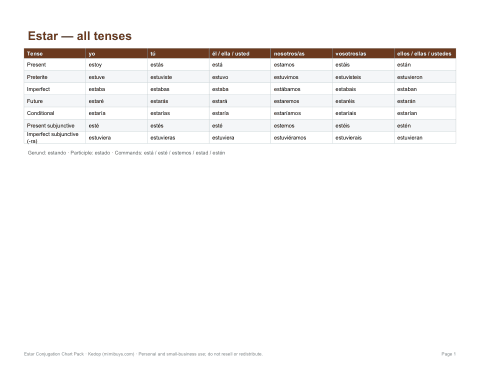
- All-tenses chart (PDF/XLSX)
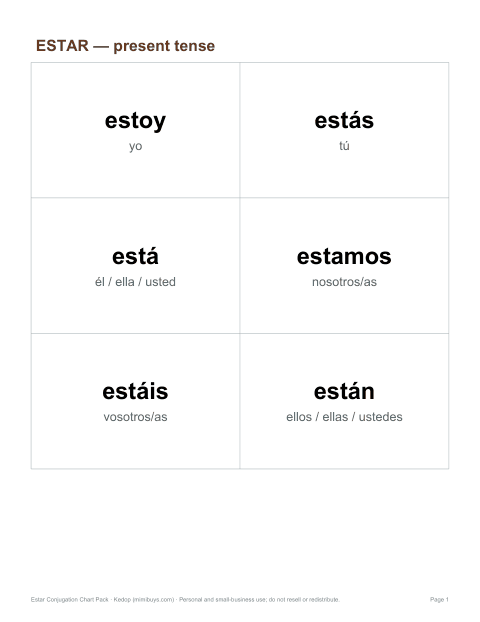
- Present poster (PDF)
- Ser vs estar (PDF/XLSX)
- + 3 more
$5.00 USD, one-time 6 files · about $0.83 each
- Instant download
- 7-day refund
- Secure checkout by Stripe
7-day money-back guarantee. Full refund within 7 days of purchase, even after you download.
Free sample: Estar All Tenses (PDF, 54 KB)
Estar Conjugation Chart Pack
Printable estar conjugation charts for every tense, a present-tense poster, a ser vs estar chart with PLACE and DOCTOR, conjugation and ser/estar worksheets with answer keys and a blank conjugation chart.
- All-tenses chart (PDF/XLSX)
- Present poster (PDF)
- Ser vs estar (PDF/XLSX)
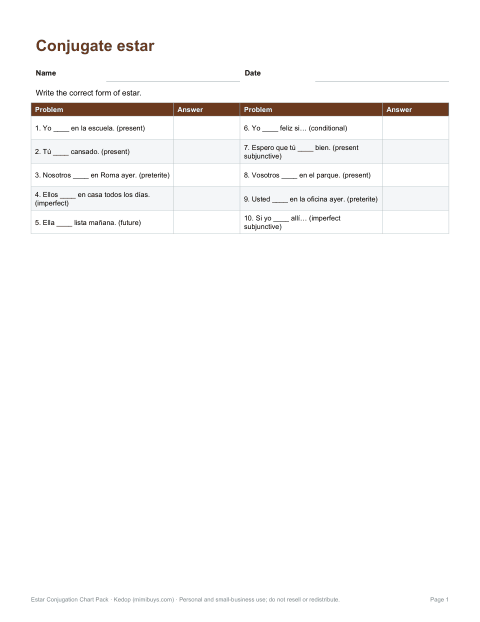
- Conjugation practice (PDF, DOCX)
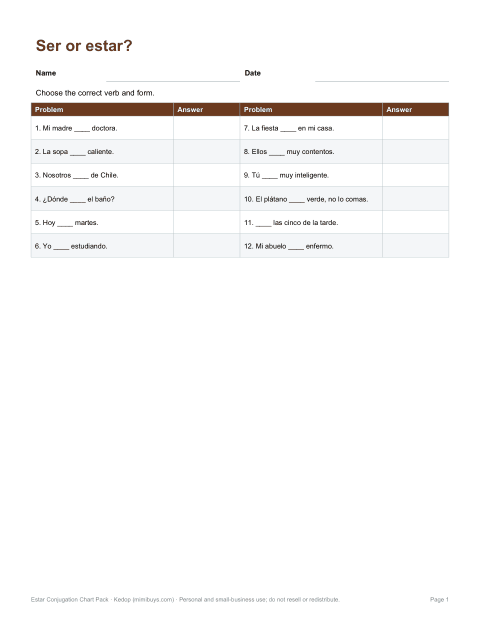
- Ser or estar? (PDF, DOCX)
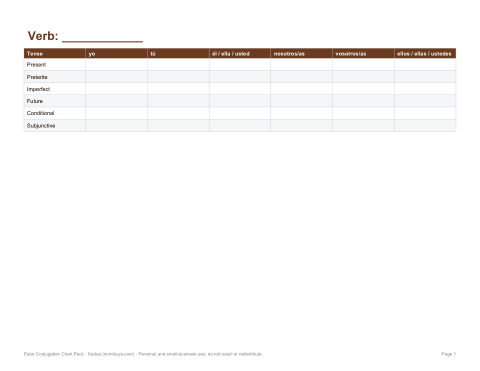
- Blank chart (PDF/DOCX)
Formats: PDF, XLSX, DOCX. Instant download after payment (link valid 72 hours, up to 5 downloads). AI-assisted: the templates were drafted with AI help and reviewed and laid out before publishing.
$5.00 USD, one-time 6 files · about $0.83 each
- Instant download
- 7-day refund
- Secure checkout by Stripe
7-day money-back guarantee. Full refund within 7 days of purchase, even after you download.
Free sample: Estar All Tenses (PDF, 54 KB)
Full refund within 7 days — see the refund policy and license.
Free printables
Single sheets you can print right now, no sign-up. The full pack adds every sheet in one download plus the editable files.
 Printable Estar All-Tenses Chart1 page · free PDF
 Printable Estar Present Tense Chart1 page · free PDF
 Printable Ser vs Estar Chart1 page · free PDF
 Printable Estar Conjugation Practice Sheet2 pages · free PDF
 Printable Ser or Estar Practice Sheet2 pages · free PDF
 Printable Estar Conjugation Chart1 page · free PDF
Estar in the present tense
| Person | Estar | Example |
|---|---|---|
| yo | estoy | Estoy en casa. |
| tú | estás | ¿Cómo estás? |
| él / ella / usted | está | Ella está cansada. |
| nosotros/as | estamos | Estamos listos. |
| vosotros/as | estáis | ¿Estáis bien? |
| ellos / ellas / ustedes | están | Están en la playa. |
Notice the accents on estás, está, estáis and están — the stress falls on the last syllable. Without the accent, esta and estas are demonstratives meaning “this”.
Estar in all tenses
| Tense | yo | tú | él / ella / usted | nosotros/as | vosotros/as | ellos / ellas / ustedes |
|---|---|---|---|---|---|---|
| Present | estoy | estás | está | estamos | estáis | están |
| Preterite | estuve | estuviste | estuvo | estuvimos | estuvisteis | estuvieron |
| Imperfect | estaba | estabas | estaba | estábamos | estabais | estaban |
| Future | estaré | estarás | estará | estaremos | estaréis | estarán |
| Conditional | estaría | estarías | estaría | estaríamos | estaríais | estarían |
| Present subjunctive | esté | estés | esté | estemos | estéis | estén |
| Imperfect subjunctive (-ra) | estuviera | estuvieras | estuviera | estuviéramos | estuvierais | estuvieran |
Commands, gerund and participle
| Form | Estar |
|---|---|
| Gerund (present participle) | estando |
| Past participle | estado |
| Command (tú) — affirmative / negative | ¡está! / ¡no estés! |
| Command (usted) | ¡esté! / ¡no esté! |
| Command (nosotros) | ¡estemos! / ¡no estemos! |
| Command (vosotros) | ¡estad! / ¡no estéis! |
| Command (ustedes) | ¡estén! / ¡no estén! |
| Present perfect | he / has / ha / hemos / habéis / han estado |
Commands with estar are common with adjectives of state: ¡Estate quieto! (Keep still!), ¡Esté tranquilo! (Stay calm!). With the reflexive pronoun, the tú command becomes estate.
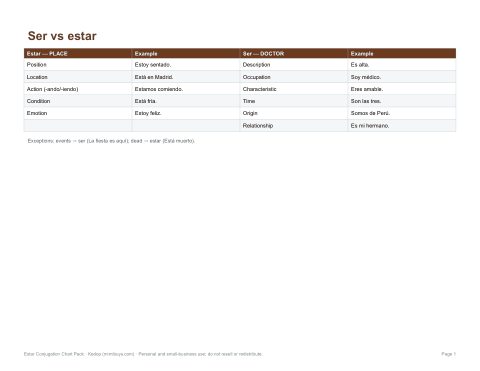
When to use estar: PLACE
| Letter | Use | Example |
|---|---|---|
| P | Position | Estoy sentado. (I am sitting.) |
| L | Location | Madrid está en España. |
| A | Action — progressive tenses | Estamos comiendo. (We are eating.) |
| C | Condition | La sopa está fría. |
| E | Emotion | Estoy contento. |
When to use ser: DOCTOR
| Letter | Use | Example |
|---|---|---|
| D | Description | Ella es alta. |
| O | Occupation | Soy profesora. |
| C | Characteristic | Eres muy amable. |
| T | Time and dates | Son las tres. Hoy es lunes. |
| O | Origin | Somos de México. |
| R | Relationship | Él es mi hermano. |
Two useful exceptions: the location of an event uses ser (La fiesta es en mi casa), and being dead uses estar (Está muerto), even though death is permanent.
Adjectives that change meaning
| Adjective | With ser | With estar |
|---|---|---|
| listo | clever | ready |
| aburrido | boring | bored |
| malo | bad | ill |
| rico | rich | tasty |
| verde | green | unripe |
| vivo | lively, sharp | alive |
| orgulloso | arrogant | proud (of something) |
| seguro | safe | sure, certain |
The progressive: estar + -ando / -iendo
To say what is happening right now, use estar with the gerund: estoy hablando (I am speaking), están escribiendo (they are writing). Regular gerunds end in -ando for -ar verbs and -iendo for -er and -ir verbs; some are irregular, such as leyendo (reading), durmiendo (sleeping) and pidiendo (asking for). Spanish uses the progressive less than English does: “I am going tomorrow” is simply voy mañana.
What is in the printable pack
- A one-page estar chart with all persons and tenses.
- A present-tense poster for classroom walls.
- A ser vs estar chart with PLACE and DOCTOR and the meaning-change adjectives.
- Fill-in-the-blank conjugation worksheets with answer keys.
- A ser or estar? practice sheet with 20 sentences and answers.
- A blank conjugation chart for any verb.
Formats and printing
PDF charts print on US Letter and A4; worksheets are also supplied in Word so teachers can add their own sentences.
AI-assisted content
Charts and worksheets were prepared with AI assistance and checked before publishing against standard Spanish conjugation tables.
Frequently asked questions
How do you conjugate estar in the present?
Estoy, estás, está, estamos, estáis, están.
What is the preterite of estar?
Estuve, estuviste, estuvo, estuvimos, estuvisteis, estuvieron.
What is the difference between ser and estar?
Estar is for position, location, actions in progress, conditions and emotions; ser is for description, occupation, characteristics, time, origin and relationships.
Why does está have an accent?
The stress falls on the last syllable; esta without an accent means “this”.
Are answer keys included?
Yes, for every worksheet.
Is this a subscription?
No, it is a one-time download.